
Freight forwarding is the coordination of moving goods across international borders through a network of ocean carriers, airlines, trucking companies, customs authorities, and logistics intermediaries. The U.S. Department of Commerce defines freight forwarders as companies that move cargo from dock to door and notes that ocean freight forwarders and NVOCCs are licensed and regulated by the Federal Maritime Commission.
Most freight forwarders are asset-light. They do not own the ships, planes, or trucks that physically move your cargo. They act as intermediaries who negotiate rates, book cargo space, prepare documentation, coordinate customs clearance, and manage the chain of handoffs that gets a product from a factory overseas to a warehouse in the United States. Their value is in the coordination, the carrier relationships, and the regulatory knowledge that keeps shipments from getting stuck.
If you manufacture or source products overseas and sell them in the United States, someone needs to manage the process of getting those goods from the factory to a domestic warehouse. Some large companies handle this in-house with their own logistics teams, licensed customs brokers, and direct carrier contracts. Most small and mid-size brands hire a freight forwarder because the complexity of international shipping, customs compliance, and multi-modal carrier coordination requires specialized expertise that does not make sense to build internally until you are moving serious volume. Either way, this step is the bridge between manufacturing and fulfillment.
We write this from a specific perspective. Jay Group is a 3PL provider with over 60 years of experience receiving inbound shipments from freight forwarders at our four fulfillment facilities across the United States. We do not operate as a freight forwarder. But we see the results of freight forwarding every day: containers that arrive on time with clean documentation, and containers that arrive late with mismatched packing lists and no advance notice. The difference between those two outcomes is almost always the quality of the freight forwarder.
This guide breaks down how freight forwarding works, what it costs, when you need one versus a 3PL (or both), and what to look for when choosing a forwarder.
How Freight Forwarding Works: The Five Stages
Freight forwarding is not a single service. It is a sequence of coordinated stages, each handled by different parties but orchestrated by the freight forwarder. Here is what happens from the moment your goods leave the manufacturer to the moment they arrive at a U.S. warehouse ready for fulfillment.
Stage 1: Cargo Booking and Route Planning
The freight forwarder evaluates your shipment (volume, weight, product type, origin, destination, and timeline) and determines the best transportation mode and route. The U.S. Department of Commerce shipping options guide provides an overview of the modes available to importers and exporters. The decision comes down to three factors: how much product you are shipping, how fast you need it, and what you are willing to spend.
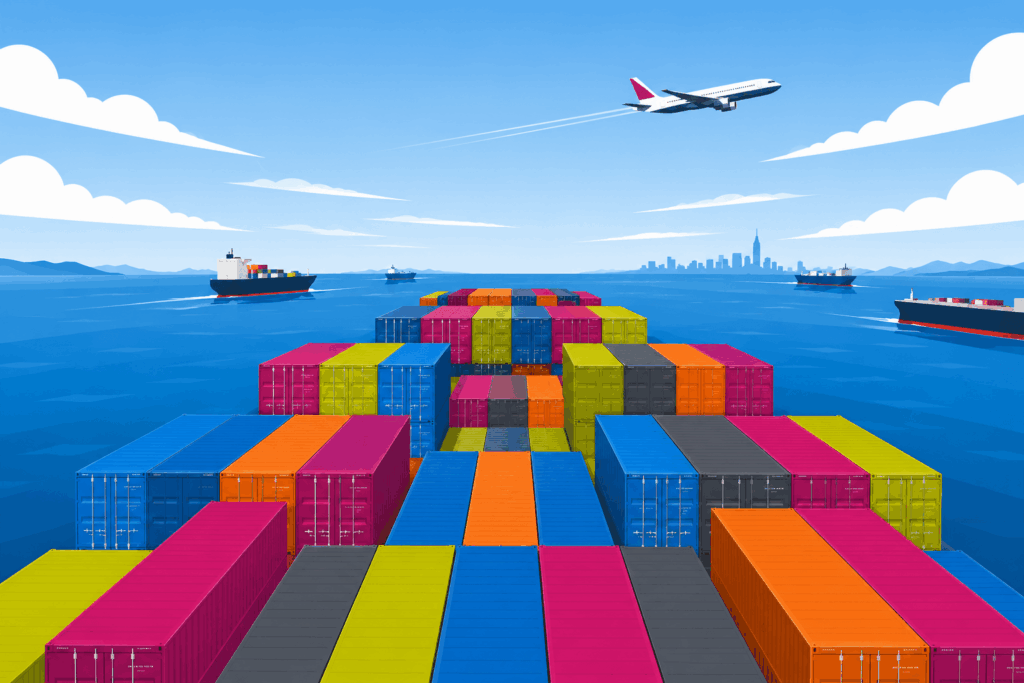
Ocean freight is the standard for large shipments. A standard 40-foot container provides approximately 2,350 cubic feet of internal volume, with usable cargo space of roughly 2,000 cubic feet after accounting for pallet stacking and load optimization. A 40-foot high-cube container (the most common type in international trade) adds about 340 cubic feet. Vessel transit time from China to the U.S. West Coast runs 12 to 18 days. To the East Coast via the Panama Canal, expect 25 to 35 days. These are vessel-only times. Add 3 to 7 days for origin-side logistics (inland transport from the factory, container stuffing, port cutoff scheduling) and 3 to 10 days on the U.S. side for customs clearance plus drayage to the warehouse. Total door-to-warehouse time typically runs 4 to 7 weeks by ocean depending on route and season.
Air freight is faster (3 to 7 days from most origins to the U.S.) but significantly more expensive. Air freight is priced per kilogram, while ocean freight is priced per cubic meter (LCL) or per container (FCL), which makes direct cost comparisons misleading. As a general benchmark, air freight for a given shipment typically costs several times more than ocean for the same goods. It makes economic sense for high-value, time-sensitive, or lightweight products where the speed advantage justifies the premium.
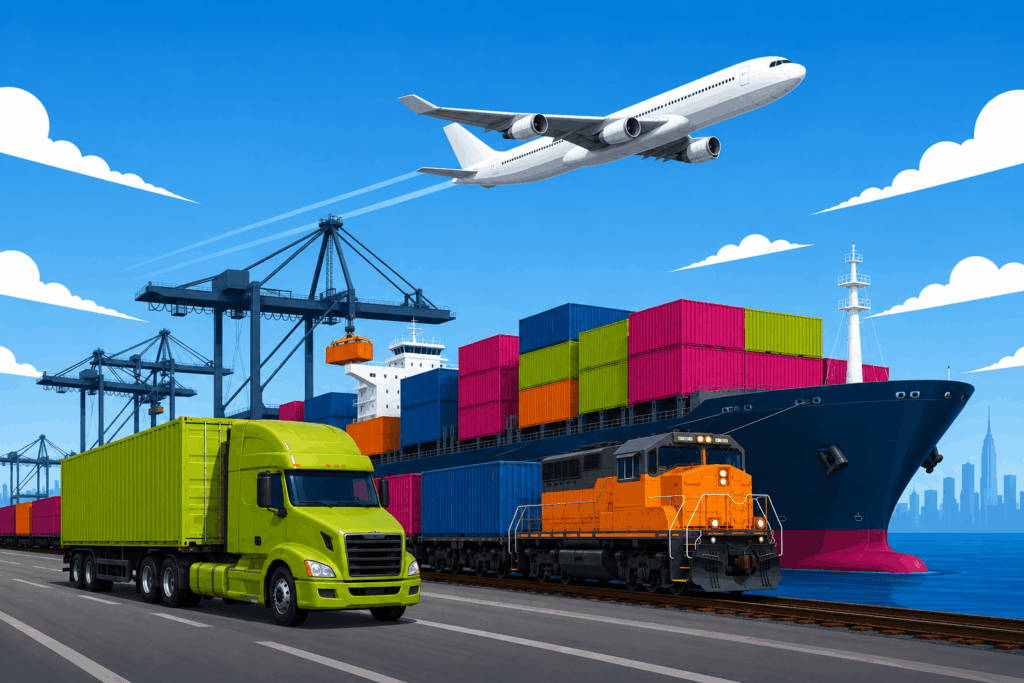
Drayage and intermodal handle the domestic leg after a container clears the port. These are two different services that importers often confuse. Drayage is short-haul trucking from the port terminal to a nearby warehouse, typically under 100 miles. This is how most containers reach their final destination if the warehouse is near the port. Intermodal rail is long-haul transport used when the destination warehouse is far from the port of entry. A container arriving at the Port of Los Angeles destined for a warehouse in Chicago, for example, would move by rail on an intermodal service, adding 5 to 7 days but costing significantly less than long-haul trucking. The freight forwarder decides whether drayage or intermodal makes more sense based on distance, cost, and timeline.
Stage 2: Documentation and Compliance
International shipping requires a stack of documents that must be accurate, complete, and filed on time. Errors create delays, penalties, and customs holds. The CBP guide to importing into the United States details the full scope of requirements, and the SBA’s import and export laws page outlines federal requirements that apply to small and mid-size businesses.
The key documents:
Commercial invoice. Describes the goods, their value, and the terms of sale. Customs authorities use this to assess duties. Inaccurate valuations trigger audits.
Bill of lading (ocean) or air waybill (air). The contract between the shipper and the carrier. It serves as proof of shipment, a receipt for the goods, and a document of title. The bill of lading is the single most important document in ocean freight because it controls who can claim the cargo at the destination.
Packing list. Details the contents of each carton, pallet, or container, including quantities, weights, and dimensions. From a 3PL’s perspective, this document is critical. When the packing list does not match what actually arrives at the warehouse, receiving takes longer and inventory discrepancies start on day one.
Certificate of origin. Declares where the goods were manufactured. The U.S. Customs and Border Protection (CBP) uses this to determine applicable tariffs and trade agreement eligibility. Country of origin directly affects duty rates, especially with the Section 301 tariffs currently applied to Chinese goods.
HTS classification. Every product imported into the United States must be classified under the Harmonized Tariff Schedule, maintained by the U.S. International Trade Commission. The HTS code determines the duty rate. Misclassification is one of the most common and expensive freight forwarding mistakes: overpay and you waste money, underpay and CBP assesses penalties with interest.
ISF (Importer Security Filing). For ocean shipments to the U.S., the importer or their agent must file an ISF (also called “10+2”) at least 24 hours before goods are loaded onto a vessel at the origin port. Failure to file results in penalties of $5,000 per violation, assessed by CBP. Late filing is not a gray area. CBP enforces this consistently.
One point that many brands overlook: hiring a freight forwarder does not transfer your legal liability. You are the importer of record. If documentation contains errors, if goods are misclassified, if duties are underpaid, the liability falls on you, not your forwarder. This is the single most important thing to understand about freight forwarding. Choose a forwarder who gets documentation right because their mistakes become your fines.
Stage 3: Customs Clearance
When goods arrive at a U.S. port or airport, they must clear customs before they can be released. This involves presenting documentation to CBP, paying applicable duties and taxes, and passing any inspections CBP selects. The CBP basic importing and exporting page and their tips for new importers are required reading for brands shipping internationally for the first time.
Customs clearance is handled by a licensed customs broker, which may be the freight forwarder themselves (if they hold a customs broker license) or a separate firm the forwarder works with. The CBP website maintains a directory of licensed customs brokers. Not every freight forwarder is a licensed customs broker. Ask.
Customs delays are one of the biggest risks in international shipping. A shipment flagged for examination can be held for 5 to 21 days, and there is no way to speed up the process once CBP initiates an inspection. Examinations can also incur additional costs: container unloading, examination fees, chassis charges while the container sits. The best defense against customs delays is accurate documentation, correct HTS classification, and a forwarder with a low examination rate on your specific trade lanes.
Stage 4: Cargo Insurance
Freight forwarding involves real risk. Containers fall off ships. The World Shipping Council estimates that over 1,500 containers are lost at sea annually. Cargo gets damaged in transit from rough seas, improper stacking, or temperature fluctuations. Theft occurs at ports and during ground transport, particularly for high-value consumer goods.
Carrier liability is limited. Under the U.S. Carriage of Goods by Sea Act (COGSA), carrier liability for cargo damage is capped at $500 per package or customary freight unit. For a container of consumer products worth $50,000 to $200,000, that default coverage is inadequate by an order of magnitude.
Freight forwarders offer marine cargo insurance or can help you arrange it through specialized underwriters. The cost is typically 0.3% to 0.5% of the declared cargo value. On a $100,000 shipment, that is $300 to $500 for full coverage. It is one of the most cost-effective protections in the entire supply chain. Not carrying it is a gamble that is not worth taking.
Zone Skipping for Ecommerce: A Regional Injection Strategy That Can Save Up to 30%
Stage 5: Last Mile to the Warehouse
Once goods clear customs, the freight forwarder arranges drayage or intermodal transport to the destination, which for most brands importing products is a fulfillment warehouse.
This is where freight forwarding ends and fulfillment begins. The goods arrive at the warehouse, get received into the warehouse management system, are inspected and counted, and placed into storage locations. From there, the 3PL takes over: picking, packing, and shipping individual orders to customers. Brands that need additional processing after receiving, like kitting and assembly, subscription box preparation, or retail-ready packaging, handle that between receiving and outbound shipping.
This handoff between freight forwarding and fulfillment is where we see supply chains break down most often. After 60 years of receiving containers at Jay Group, the pattern is consistent: when the freight forwarder communicates well and documents accurately, receiving is fast and inventory is clean. When they do not, the problems cascade.
The most common receiving failures we see:
No advance shipping notice (ASN). A container shows up at the dock with no prior notification. The warehouse has no receiving labor scheduled, no storage locations prepped, and no way to verify what is inside until someone opens the doors.
Packing list does not match contents. The packing list says 500 units per carton, 40 cartons. The container has 480 units per carton and 42 cartons. Now receiving has to count everything manually, and your inventory numbers are wrong from the start.
No delivery appointment. The drayage driver arrives without a scheduled dock appointment. The truck waits (incurring detention charges) or leaves and comes back, adding a day or more to your receiving timeline.
Mislabeled cartons. Barcodes on cartons do not match the 3PL’s system. Every carton has to be relabeled at the warehouse before it can be put away. That is labor cost you should not be paying.
Jay Group’s warehouse management system is built to handle inbound shipments efficiently across all four of our facilities in Lancaster, PA (250,000 sq ft), Mountville, PA (140,000 sq ft), Houston, TX (240,000 sq ft), and Reno, NV (130,000 sq ft). We process ASNs electronically, schedule dock appointments in advance, and flag receiving discrepancies at the point of receipt. For brands importing FDA-regulated products like supplements, cosmetics, medical devices, or food, all four facilities are FDA-registered and cGMP-compliant, which means imported goods move directly into a compliant storage environment without requiring a separate transfer. Climate-controlled zones protect temperature-sensitive imports from the moment they arrive.
Freight Forwarding vs. 3PL: Two Different Jobs
This is one of the most common points of confusion for brands building out their supply chain. Freight forwarding and 3PL logistics operate at different stages and serve different functions. Most growing brands need both.
| Freight Forwarder | 3PL (Third-Party Logistics) | |
| Primary function | Moves goods from origin to destination across borders | Stores goods and fulfills individual orders |
| Scope | International and domestic transportation, customs | Warehousing, pick/pack/ship, returns |
| Infrastructure | Typically asset-light, arranges carrier services | Operates dedicated warehouse facilities |
| Handles customs? | Yes (directly or through licensed brokers) | Rarely |
| Handles individual orders? | No | Yes |
| Integrates with ecommerce? | No | Yes (Shopify, Amazon, WooCommerce, etc.) |
| When you use them | Importing inventory from manufacturers | Storing inventory and shipping orders to customers |
The typical flow for a brand that imports products:
- Manufacturer produces your goods overseas
- Freight forwarder moves goods from the manufacturer to a U.S. warehouse
- 3PL receives the goods, stores them, and fulfills individual customer orders
Some companies offer both services under one roof. This can simplify coordination but is not always the best option if the company is stronger in one area than the other. Evaluate each function on its own merits. (For a detailed guide on evaluating 3PL providers specifically, see our article on how to find a logistics company.)
Jay Group specializes in warehousing and order fulfillment across multiple industries. We coordinate closely with our clients’ freight forwarders to ensure the transition from international transport to domestic fulfillment is seamless.
When You Need a Freight Forwarder
You source or manufacture products overseas. If your products are made in China, Vietnam, India, Europe, or anywhere outside the United States, a freight forwarder handles the international leg. This applies whether you sell through ecommerce, retail, wholesale, or all three.
You are importing commercial quantities. Freight forwarding makes economic sense when you are shipping pallets or containers. If you are ordering a few hundred units from a supplier who ships via express courier (DHL, FedEx International), you probably do not need a forwarder. The courier handles everything. Once you are ordering thousands of units and filling containers, a freight forwarder will save you money and handle the customs complexity that comes with formal import entries.
You need customs expertise for regulated products. If you are importing supplements, medical devices, food and beverage, or hazardous materials, the customs requirements go beyond standard documentation. FDA Prior Notice, product-specific labeling requirements, and the FDA’s PREDICT system that flags shipments for examination all require a forwarder with specific experience in your product category.
You are moving goods between countries for any reason. Even if you manufacture in the U.S. and sell internationally, freight forwarding handles export documentation, carrier coordination, and destination country customs requirements.
 When You Do Not Need a Freight Forwarder
You source everything domestically. If your manufacturers and suppliers are all within the United States, domestic trucking and LTL carriers handle transportation. A 3PL can often coordinate inbound freight from domestic suppliers as part of their service.
Your supplier ships DDP. Some overseas suppliers offer DDP (Delivered Duty Paid) terms that include freight forwarding as part of the purchase price. If your supplier manages the full transport, duties, and delivery to your warehouse, you are using freight forwarding services indirectly through them.
You ship very small quantities. For low-volume imports (under 2 to 3 CBM of cargo), express courier services may be more cost-effective than engaging a freight forwarder. The administrative overhead of formal customs entries does not make sense for a few boxes.
How Much Does Freight Forwarding Cost?
Freight forwarding costs depend on transportation mode, origin, destination, cargo volume, product type, and current market conditions. Freight rates are volatile. The Red Sea crisis that began in late 2023, when Houthi attacks forced most carriers to reroute around the Cape of Good Hope, added 10 to 14 days to Asia-Europe routes and pushed container rates up 80% or more compared to pre-crisis levels. While the situation has evolved, the point holds: the cost ranges below are benchmarks, not guarantees. Get current quotes for your specific lanes.
Ocean Freight
Full Container Load (FCL): A 20-foot container from China to the U.S. West Coast typically costs $1,500 to $4,000 for the ocean leg. A 40-foot container runs $2,500 to $6,000. East Coast destinations add $1,000 to $2,000 due to longer transit via the Panama Canal or Suez Canal routing. These are carrier rates for the ocean transit only. They do not include origin charges, customs fees, or destination-side costs.
Less than Container Load (LCL): If your shipment does not fill a full container, LCL pricing runs $50 to $100 per cubic meter (CBM). Your shipment shares container space with other shippers’ cargo, which adds 1 to 2 weeks for consolidation at origin and deconsolidation at destination. If your shipment fills at least half a 20-foot container, FCL is usually more cost-effective despite paying for unused space.
Air Freight
Air freight rates typically run $4 to $8 per kilogram for standard goods, with surcharges for oversized, hazardous, or temperature-sensitive cargo. Air freight makes sense when the value-to-weight ratio of your product justifies the premium or when speed is critical, such as restocking a best-selling SKU that is about to go out of stock.
Origin Charges (Often Overlooked)
Before your shipment even reaches the ocean or air carrier, there are origin-side costs: inland transport from the factory to the port, container stuffing (loading goods into the container), port handling, and documentation fees at origin. These vary by country but typically add $300 to $800 per container.
Destination Charges
Customs brokerage fees ($150 to $300 per entry), ISF filing ($25 to $50), port handling and terminal charges ($200 to $500 per container), and drayage from port to warehouse ($300 to $1,500+ depending on distance and availability). Cargo insurance adds 0.3% to 0.5% of cargo value.
Demurrage and Detention
Two costs that surprise first-time importers. Demurrage is the charge for leaving your container at the port terminal beyond the free time (typically 3 to 5 days). Detention is the charge for keeping the container chassis outside the port beyond the allotted time. Rates start at $75 to $150 per day and escalate quickly, sometimes doubling after the first week. A container stuck at port for two weeks can easily accumulate $1,500 to $3,000 in demurrage and detention charges alone. Fast customs clearance and a warehouse ready to receive are the best defenses.
De Minimis Exemption
Shipments valued under $800 may qualify for the Section 321 de minimis exemption, which allows duty-free entry without a formal customs entry. This is relevant for brands importing small, high-frequency shipments directly to end customers. Recent regulatory changes have tightened eligibility, particularly for goods originating from China. Verify current rules before relying on this exemption.
Total Landed Cost
The total landed cost of bringing a container from overseas to a U.S. fulfillment warehouse includes all of the above: origin charges, ocean or air freight, insurance, customs brokerage, duties and taxes, port handling, drayage, and warehouse receiving. A reliable freight forwarder provides an all-in quote that covers every cost rather than surprising you with add-on charges after the shipment is in transit.
Freight Forwarding Licensing and Regulation
Freight forwarding in the United States is regulated by two federal agencies depending on the transportation mode.
Ocean Freight Forwarding
Ocean freight forwarders are regulated by the Federal Maritime Commission (FMC). Any company operating as an Ocean Transportation Intermediary (OTI) in the U.S. must hold an FMC license. There are two types:
Ocean Freight Forwarder (OFF) license: For companies that arrange ocean transportation on behalf of shippers. Requires a $50,000 surety bond and a qualifying individual with at least 3 years of experience in ocean freight.
Non-Vessel-Operating Common Carrier (NVOCC) license: For companies that issue their own bills of lading and accept responsibility for cargo. Requires a $75,000 surety bond.
You can verify a freight forwarder’s FMC license through the FMC’s online search tool.
Domestic Freight Brokerage
Domestic freight brokers and forwarders are regulated by the Federal Motor Carrier Safety Administration (FMCSA), a division of the U.S. Department of Transportation. Requirements include a USDOT number and MC number, a $75,000 surety bond or trust fund agreement, process agent designation in every state of operation, and Unified Carrier Registration. Verify a broker’s authority through the FMCSA’s SAFER system.
Why Licensing Matters
Working with an unlicensed freight forwarder exposes you to real financial risk. If a shipment goes wrong and your forwarder has no bond, there is no financial recourse. If they operate without proper authority and CBP identifies the issue, your shipment can be held or seized. Always verify licensing before engaging a freight forwarder. It takes two minutes online.
How to Choose a Freight Forwarder
Experience with Your Product Category
A freight forwarder that moves auto parts operates differently than one that moves beauty products or food and beverage. If your products require temperature control, hazmat classification, FDA pre-clearance, or any other specialized handling, your freight forwarder must have documented experience with those requirements. Ask for client references in your specific product category, not just general references.
Customs Accuracy
Ask about their HTS classification process. Do they use licensed customs brokers? What is their examination rate (the percentage of shipments CBP selects for inspection)? A high examination rate suggests documentation problems. A rate under 3% indicates a well-run customs operation.
Communication and Tracking
You should be able to see where your shipment is at every stage: booked, departed origin, in transit, arrived at port, cleared customs, in drayage, delivered to warehouse. If the forwarder’s updates consist of “we will let you know when it arrives,” find a different forwarder. Real-time visibility is not optional anymore.
Network and Carrier Relationships
A freight forwarder’s value comes from their carrier relationships. Ask who their preferred carriers are on your specific lanes, how many carriers they work with, and whether they can provide backup options when bookings fall through. The Suez Canal blockage in 2021, the port congestion crisis of 2021-2022, and the Red Sea shipping disruption that began in late 2023 all proved the same point: supply chain disruptions are not rare events. They are recurring realities. Freight forwarders with deep carrier networks and multiple routing options adapt. Those with limited relationships scramble, and your shipments are the ones that get delayed. For brands new to international shipping, Georgia Tech’s Introduction to International Logistics and Compliance and American University’s Essentials of Freight Forwarding program both provide practical foundations for understanding how these carrier networks function.
Financial Stability and Insurance
Verify their bonding, insurance coverage, and years in business. A freight forwarder that goes out of business mid-shipment creates a complicated and expensive recovery process. The NCBFAA (National Customs Brokers & Forwarders Association of America) is the industry’s primary trade association, and membership is a positive signal, though not a guarantee of quality.
FAQ
What is freight forwarding in simple terms?
Freight forwarding is a service that coordinates the shipment of goods from one country to another. A freight forwarder acts as an intermediary between you and the carriers (shipping lines, airlines, trucking companies) that physically move the goods. They handle booking cargo space, preparing customs documentation, clearing goods through customs, and arranging delivery to the final destination. You hire them because navigating international shipping regulations, carrier negotiations, and customs compliance is a full-time specialty.
Do I need a freight forwarder if I buy from Alibaba or overseas suppliers?
It depends on volume. If you are ordering small quantities (a few hundred units) and your supplier ships via express courier (DHL, FedEx, UPS International), you probably do not need a freight forwarder. The courier handles customs and delivery. Once you are ordering pallets or containers, a freight forwarder saves money on transportation and handles the customs complexity that comes with formal import entries. The break-even point is usually around 2 to 3 CBM (cubic meters) of cargo, where freight forwarding rates start beating courier rates.
How long does freight forwarding take from start to finish?
Total door-to-warehouse time, not just vessel transit. Ocean freight from Asia to the U.S. West Coast: 4 to 6 weeks total (12-18 days vessel transit, plus 3-7 days origin logistics, plus 3-10 days U.S. customs and drayage). To the East Coast: 5 to 7 weeks. Air freight: 1 to 2 weeks total (3-7 days in the air, plus customs and local delivery). These ranges assume no customs holds or port congestion. During peak season (August through November) or major disruptions, add additional buffer time.
What is the difference between FCL and LCL?
FCL (Full Container Load) means you book an entire container for your shipment. You pay a flat rate per container regardless of whether you fill it completely. LCL (Less than Container Load) means your shipment shares container space with other shippers’ cargo. LCL is cheaper for small shipments but slower (add 1 to 2 weeks for consolidation at origin and deconsolidation at destination) and carries slightly higher risk of damage from additional handling. If your shipment fills at least half a 20-foot container, FCL is usually more cost-effective.
What duties and taxes apply when importing goods to the U.S.?
All goods imported into the United States are subject to duties based on their HTS classification. Duty rates vary from 0% to over 25% depending on the product and country of origin. Chinese goods are currently subject to additional Section 301 tariffs on top of standard duty rates. In addition to duties, Merchandise Processing Fee (MPF) of 0.3464% of cargo value applies (minimum $31.67, maximum $614.35 per entry), and Harbor Maintenance Fee (HMF) of 0.125% of cargo value applies to ocean shipments. Your customs broker or freight forwarder calculates and pays these on your behalf as part of the customs entry process.
Can a freight forwarder help with FDA-regulated products?
Yes, experienced freight forwarders handle FDA-regulated imports regularly. Products like food, dietary supplements, cosmetics, medical devices, and pharmaceuticals require specific documentation and may be subject to FDA examination at the port. Your freight forwarder should be familiar with Prior Notice requirements for food products, FDA registration requirements for your product type, and the FDA’s PREDICT system that flags shipments for examination. Once FDA-regulated products clear customs and arrive at their destination, they need compliant storage facilities. Jay Group’s warehouses are FDA-registered and cGMP-compliant, designed to handle regulated products from receiving through fulfillment without breaking the chain of compliance.
What is DDP vs. EXW in freight forwarding?
These are Incoterms that define who is responsible for shipping costs and risks at each stage of the journey. DDP (Delivered Duty Paid) means the seller handles everything: transportation, insurance, customs clearance, duties, taxes, and delivery to the buyer’s location. The buyer receives goods with all costs prepaid. EXW (Ex Works) is the opposite: the seller makes goods available at their facility, and the buyer is responsible for all transportation, customs, and delivery costs from that point forward. Most other Incoterms (FOB, CIF, DAP) fall between these two extremes. Understanding which Incoterm applies to your purchase order determines exactly where your freight forwarder’s responsibility starts and where it ends.
How do I verify a freight forwarder’s credentials?
Check three things. First, FMC license: search the Federal Maritime Commission’s database for ocean freight forwarders. Second, FMCSA authority: search the SAFER system for domestic freight brokers. Third, customs broker license: verify with CBP if they claim to handle customs brokerage directly. Beyond licensing, check for membership in the NCBFAA and ask for client references in your specific product category and trade lane.